ClinicalClarity
The Cognitive Bia-Seas
Charted
0 / 30
A reasoning tool for clinicians, residents & students
Chart the Clinical Cognitive Bia-Seas
Learn to recognize the cognitive biases and logical fallacies that quietly steer clinical decisions, so you can catch them before they reach the bedside.
Every bias and fallacy is charted to its own place on the map, each anchored to a real clinical case. Sail the coast, drop anchor at a landmark, and study how sound reasoning runs aground.
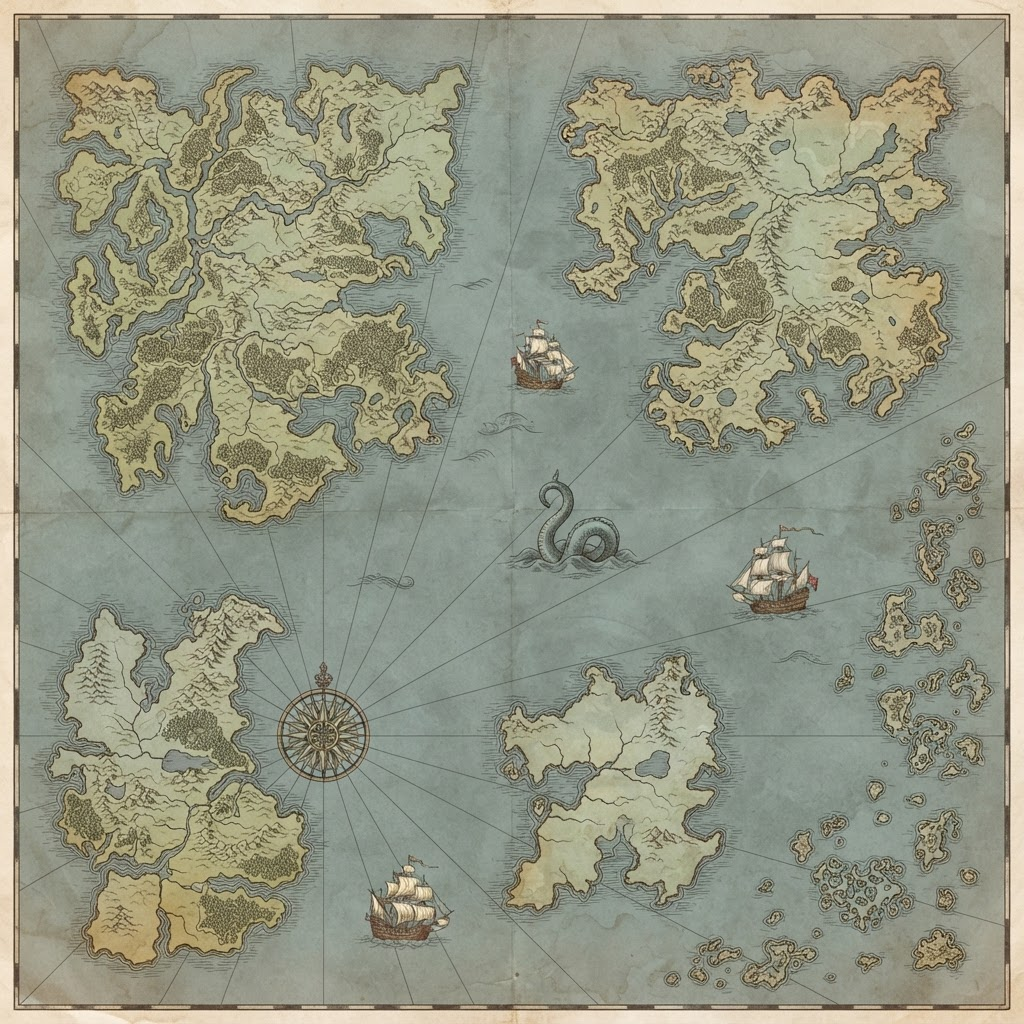
Related ideas share a coast. Hover a landmark to name it, then select to sail ashore.
Why we built ClinicalClarity
Imagine a ship on a tranquil sea. The ship is a clinician's mind; the sea represents the journey of daily clinical decision-making. The ship sets sail toward a destination, and reaching it is arriving at a decision. Too often we believe we reach decisions purely by will, when in truth the course demands constant correction against unseen forces: the wind and the currents of bias.
We built ClinicalClarity to help clinicians see some of the ways their thinking can be influenced, using real-world examples to help you chart a course toward more disciplined, rational thought and sounder clinical decisions. We believe that leads to safer care.
The atlas rests on two findings from the learning sciences. The first is the method of loci: binding each idea to a distinct place measurably strengthens recall. So every bias and fallacy keeps a fixed berth on the map, giving your memory a coastline to navigate.
The second is case-based, narrative learning, which improves clinical reasoning more than definitions alone. Each location pairs a plain definition with a real vignette and a short prompt, and the charts you visit are marked complete so you can track your voyage over time.
We owe a particular debt to the late Daniel Kahneman (1934–2024) and his book Thinking, Fast and Slow (2011), whose fast, intuitive “System 1” and slow, deliberate “System 2” give this atlas its compass. We are indebted, too, to Jerome Groopman, whose How Doctors Think (2007) showed how these currents play out at the bedside. Most of what pushes a clinician's ship off course begins as an unchecked System 1 reflex, a fast judgment reached before the evidence is in. But System 2 has its own hazards: slow, deliberate reasoning can talk itself into logical fallacies, over-correcting well past the truth and steering with false confidence into the dangerous waters of an unsound decision. The skill this atlas trains is knowing which current to trust and when to take the rudder.
A NerdcoreMedical Digital project
ClinicalClarity is built by NerdcoreMedical Digital, a studio crafting narrative-driven medical education, from continuing-education games to reasoning tools like this atlas, that make clinical learning stick.
Visit nerdcoremd.comReferences & Further Reading
The charts in this atlas are grounded in the medical literature on cognitive bias, logical fallacy, and clinical reasoning. These are the most relevant sources for learners who wish to sail further.
- Croskerry P. Achieving Quality in Clinical Decision Making: Cognitive Strategies and Detection of Bias. Academic Emergency Medicine. 2002;9(11):1184–1204.doi:10.1111/j.1553-2712.2002.tb01574.x
- Croskerry P. The Importance of Cognitive Errors in Diagnosis and Strategies to Minimize Them. Academic Medicine. 2003;78(8):775–780.doi:10.1097/00001888-200308000-00003
- Croskerry P. From Mindless to Mindful Practice — Cognitive Bias and Clinical Decision Making. New England Journal of Medicine. 2013;368(26):2445–2448.doi:10.1056/NEJMp1303712
- Croskerry P, Singhal G, Mamede S. Cognitive Debiasing 1: Origins of Bias and Theory of Debiasing. BMJ Quality & Safety. 2013;22(Suppl 2):ii58–ii64.doi:10.1136/bmjqs-2012-001712
- Saposnik G, Redelmeier D, Ruff CC, Tobler PN. Cognitive Biases Associated With Medical Decisions: A Systematic Review. BMC Medical Informatics and Decision Making. 2016;16:138.doi:10.1186/s12911-016-0377-1
- Norman GR, Monteiro SD, Sherbino J, et al. The Causes of Errors in Clinical Reasoning: Cognitive Biases, Knowledge Deficits, and Dual Process Thinking. Academic Medicine. 2017;92(1):23–30.doi:10.1097/ACM.0000000000001421
- Royce CS, Hayes MM, Schwartzstein RM. Teaching Critical Thinking: A Case for Instruction in Cognitive Biases to Reduce Diagnostic Errors and Improve Patient Safety. Academic Medicine. 2019;94(2):187–194.doi:10.1097/ACM.0000000000002518
- Reilly JB, Ogdie AR, Von Feldt JM, Myers JS. Teaching About How Doctors Think: A Longitudinal Curriculum in Cognitive Bias and Diagnostic Error for Residents. BMJ Quality & Safety. 2013;22(12):1032–1038.doi:10.1136/bmjqs-2013-001987
- Hartigan S, Brooks M, Hartley S, et al. Review of the Basics of Cognitive Error in Emergency Medicine: Still No Easy Answers. Western Journal of Emergency Medicine. 2020;21(6):1327–1334.doi:10.5811/westjem.2020.7.47832
- Prakash S, Sladek RM, Schuwirth L. Interventions to Improve Diagnostic Decision Making: A Systematic Review and Meta-Analysis on Reflective Strategies. Medical Teacher. 2019;41(5):517–524.doi:10.1080/0142159X.2018.1497786
Foundational texts
Widely referenced across the clinical-reasoning literature, though not indexed in the medical databases above:
- Kahneman D. Thinking, Fast and Slow. New York: Farrar, Straus and Giroux; 2011.
- Groopman J. How Doctors Think. Boston: Houghton Mifflin; 2007.
Take the map ashore
Wall charts for the voyage
The chart above is a curated sampling. The printed posters go further, offering a more comprehensive collection of worked biases and fallacies, with 24 biases on one and 24 fallacies on the other. Both are available from the NerdcoreMedical store.
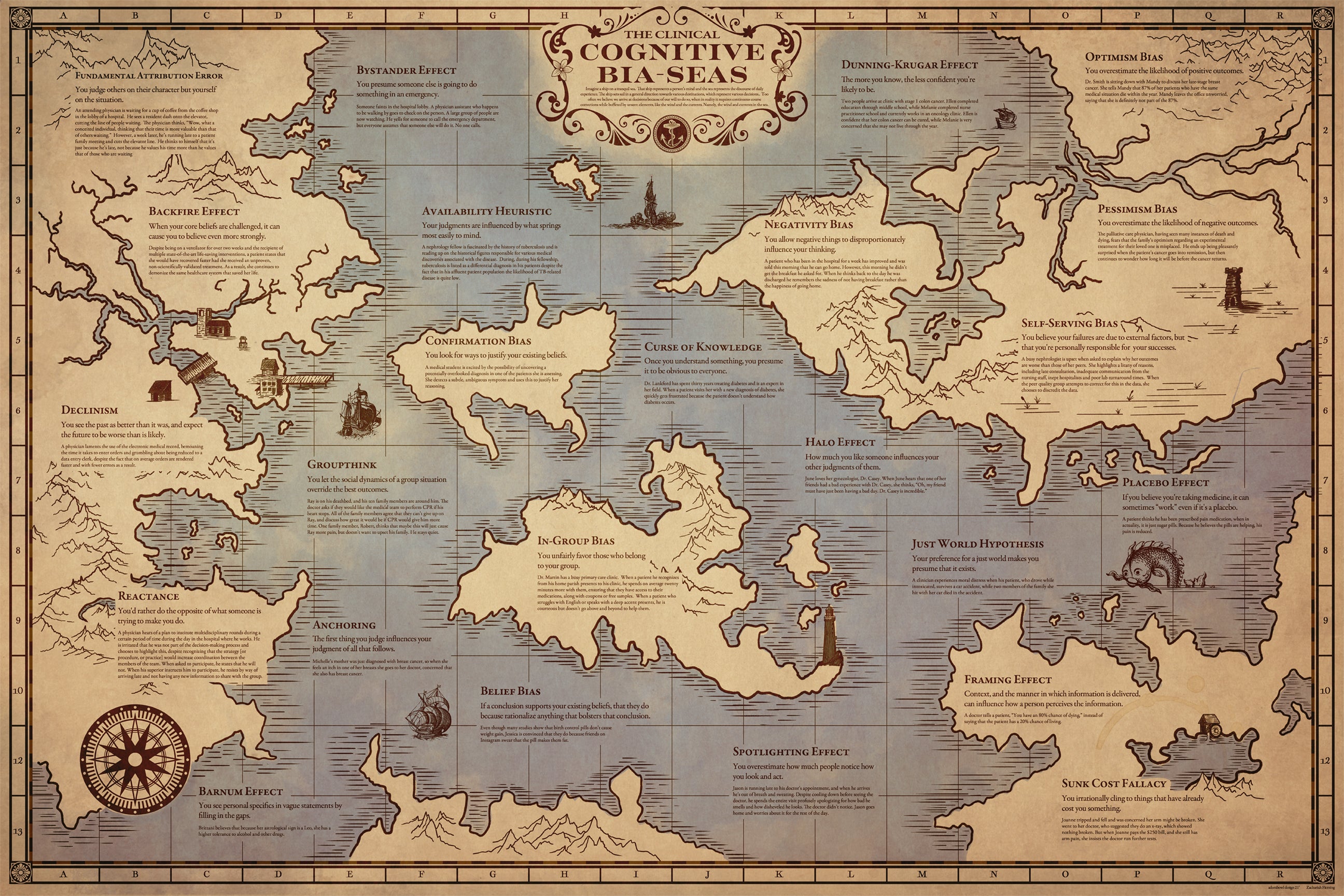
The Cognitive Bia-Seas
24 cognitive biasesA fuller, more comprehensive collection than the chart above, with 24 cognitive biases charted as coastlines, each with a clinical example, ready for the wall of your office or reading room.
View in the store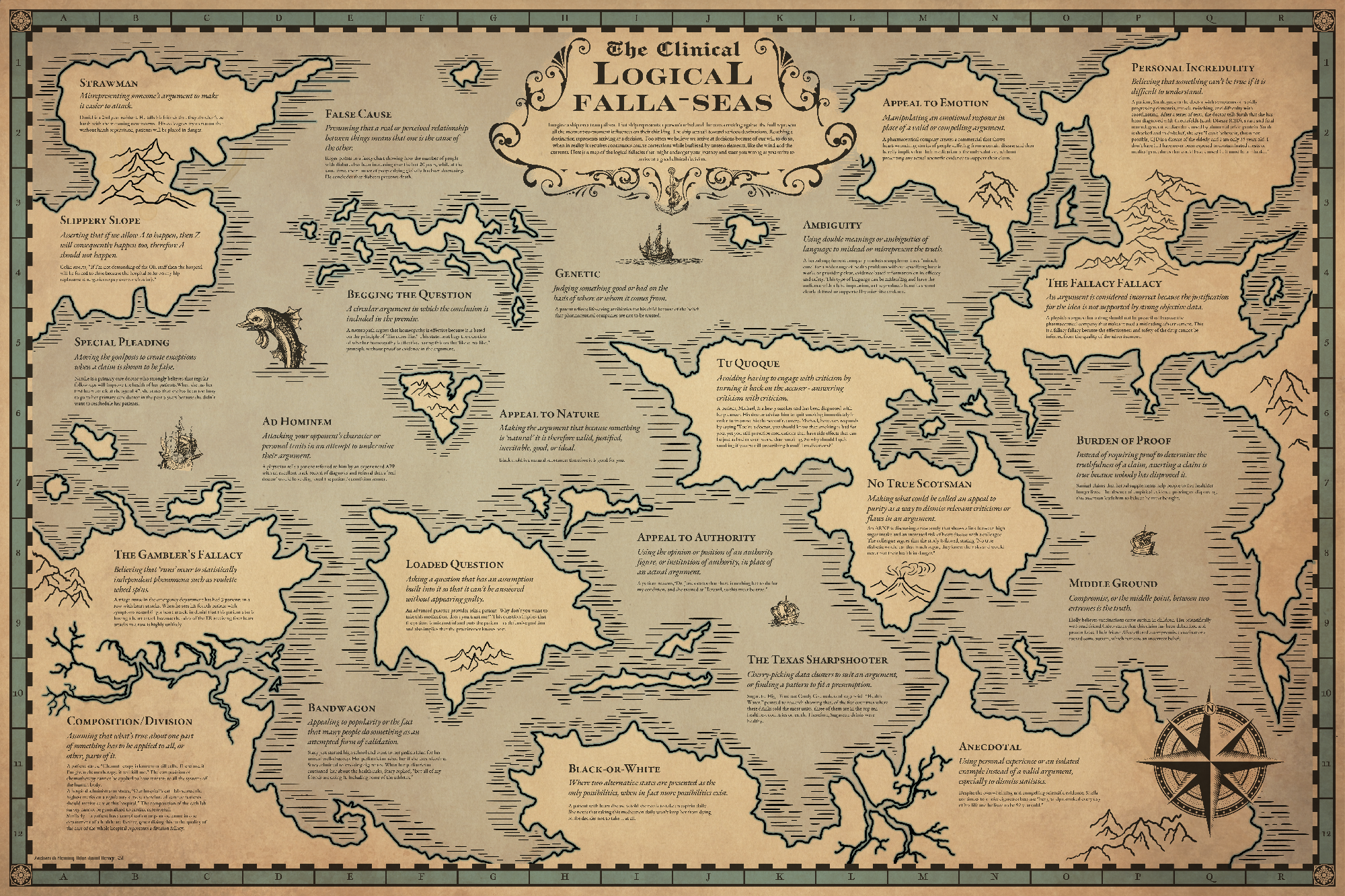
The Falla-Seas
24 logical fallaciesA companion map drawn in the same hand, the comprehensive collection of 24 logical fallacies, each illustrated with a worked example, made to hang beside the Bia-Seas.
View in the storePosters designed in collaboration with
Zachariah Fleming
We believe the human hand belongs in this work, so every poster was drawn in partnership with a real artist rather than generated. Zachariah Fleming is a graphic designer, artist, and typographer based in Raleigh, North Carolina, and his background in illustration, typography, and brand identity gave these charts their hand-lettered coastlines and antique cartographic feel.
See his work on Instagram